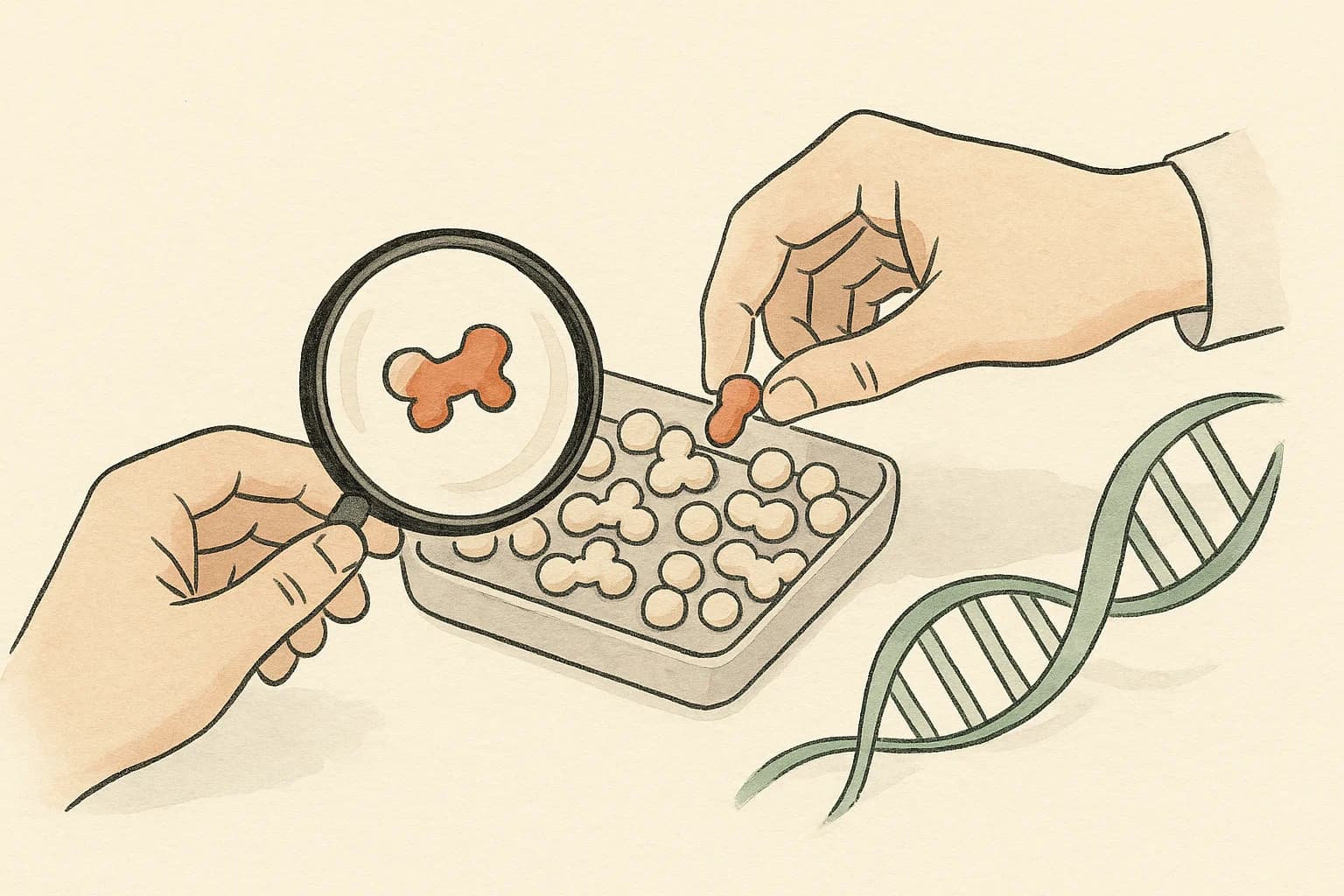
A different question for every patient
A tumour contains changes that distinguish it from healthy tissue. Some changes alter the proteins its cells make. When those proteins are broken into short fragments, they can produce peptides that differ from the normal version. These candidate targets are called neoantigens.
The personalized-vaccine idea is to identify useful tumour-specific fragments and encode selected targets in a vaccine. The goal is to help the immune system recognize cells displaying those targets. The difficult part is choosing targets that actually exist, can be presented and can provoke a relevant response.
Neoantigen Retriever is N1 Therapeutics’ computational product for that selection problem. Project Rosie was the original hackathon prototype that connected the first steps of this workflow.
Start with the tumour and a healthy comparison
Tumour DNA is sequenced alongside matched-normal material from the same patient. Comparing the two helps distinguish changes acquired by the tumour from inherited variation. The resulting variants can be represented in a VCF, or Variant Call Format file.
A VCF is a structured map of DNA changes. It does not tell us whether a change affects a protein, whether the altered gene is expressed or whether the immune system can recognize it. The original Project Rosie prototype started at this variant-file stage. It did not replace clinical sampling or the sequencing laboratory.
Translate DNA changes into candidate peptides
Variant annotation tools such as the Variant Effect Predictor help connect a DNA change to its possible effect on a gene and protein. Protein-changing variants can then be used to generate candidate peptides containing the altered amino acid.
This step turns a map of mutations into a set of biological hypotheses. Most candidates will not become useful vaccine targets. Each still needs evidence that it can be made by the tumour and encountered by the immune system.
The immune system needs a presentation step
Cells use major histocompatibility complex molecules, or MHC, to display short protein fragments to T cells. The human system is called HLA; the related canine system is DLA. Each patient has a particular set of these molecules.
The full source protein does not need to sit on the surface of the cancer cell. An intracellular protein can be processed into peptides and displayed by MHC. This is why simply looking at the surface of a predicted protein structure does not establish whether a neoantigen will be presented.
A binding prediction asks whether a peptide is compatible with a particular presentation molecule. For canine work, we also need to know whether the selected model and available evidence support the dog’s DLA alleles. Human model performance cannot simply be assumed to transfer.
Rank a body of evidence
Binding is one signal in a longer chain. A mutation may be real but present in only a small tumour branch. A gene may be poorly expressed. A peptide may bind a molecule in a prediction yet never be displayed by the tumour.
The aim is an explainable shortlist for review and experiments, rather than a score that claims to know the final answer.
- Tumour specificity: is the change absent from the matched normal?
- Clonality: how widely is it shared across the tumour?
- Expression: is there RNA evidence for the altered gene and allele?
- Presentation: can the peptide plausibly be processed and displayed?
- Recognition: does experimental evidence support a relevant immune response?
From supported targets to an investigational vaccine
Selected targets can inform an mRNA construct. The RNA encodes instructions for producing antigen fragments. A lipid nanoparticle protects the RNA and helps deliver it into cells.
The computational output is a candidate design. Manufacturing requires qualified partners, product-specific quality assessment and a separate clinical pathway. Binding and immune-response experiments help assess candidates; they do not by themselves establish that a vaccine is ready for administration.
Learn from the complete journey
Our intended workflow connects clinics, sequencing, candidate selection, wet-lab validation, mRNA-LNP manufacturing and monitoring. Properly designed studies can connect what was predicted with what was measured.
N1 Therapeutics is building that path, starting with dogs. The current development work is about earning evidence at each stage before progressing to the next.
Sources and original work
Adapted by Shashank Padala for N1 Therapeutics from his original article dated September 9, 2026. Project Rosie remains the historical prototype; Neoantigen Retriever is the current computational product.