Personalized cancer vaccines. Starting with our best friends.
Our canine research program connects tumor sequencing, computational discovery and experimental immunology to investigate personalized cancer vaccines.
Follow the path we are developing, from a dog’s diagnosis to candidate discovery, laboratory testing and potential clinical evaluation.
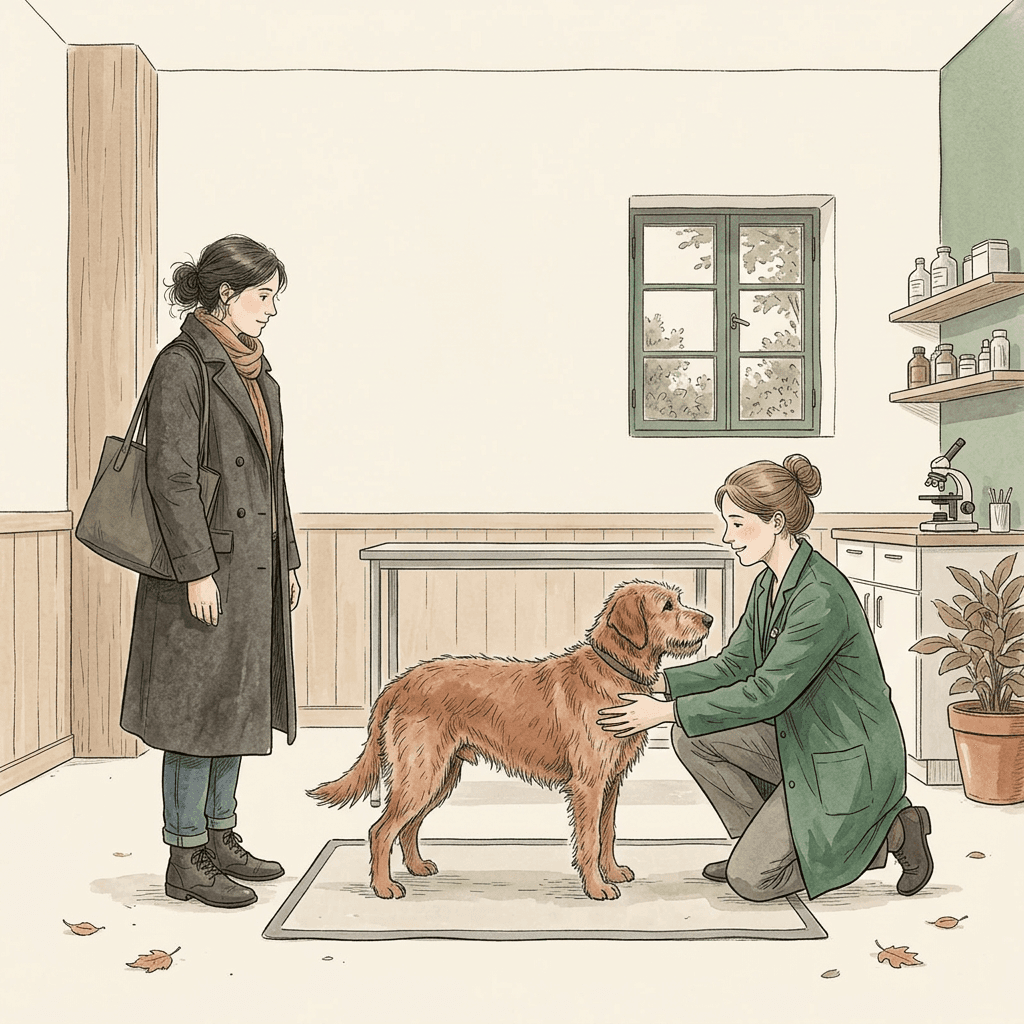
01 · A dog arrives at the clinic
Start with the patient.
The veterinary team assesses suitability and coordinates tumour and matched-normal samples.
Could a personalized neoantigen vaccine be a suitable option for this dog?
The journey begins with a diagnosis. The veterinarian reviews the dog’s clinical history, assesses suitability and coordinates tumour and matched-normal sample collection.
Partner: Veterinary oncology clinic
Explore this stage
Could a personalized neoantigen vaccine be a suitable option for this dog?
The journey begins with a diagnosis. The veterinarian reviews the dog’s clinical history, assesses suitability and coordinates tumour and matched-normal sample collection.
Patient & consentClinical samples
Patient & consentClinical samples
02 · Understand the tumour
Every tumour tells a different story.
Sequencing reveals tumour-specific changes, RNA expression and the dog’s immune-genetics context.
What has changed in this tumour that is absent from healthy tissue?
Tumour and matched-normal sequencing help identify tumour-specific changes. RNA evidence and patient-specific immune genetics add context.
Partner: DNA/RNA sequencing laboratory
Explore this stage
What has changed in this tumour that is absent from healthy tissue?
Tumour and matched-normal sequencing help identify tumour-specific changes. RNA evidence and patient-specific immune genetics add context.
Clinical samplesMolecular data
Clinical samplesMolecular data
03 · Neoantigen Retriever
Find the targets worth testing.
Neoantigen Retriever turns molecular evidence into an explainable shortlist of patient-specific targets.
Of thousands of changes, which few deserve laboratory time?
Our computational pipeline narrows tumour-specific changes into a ranked shortlist. DLA molecules help present protein fragments to the dog's immune system. We evaluate which tumour-specific fragments could be recognized.
Partner: N1 Therapeutics · Neoantigen Retriever
Assays and handoffs
Of thousands of changes, which few deserve laboratory time?
Our computational pipeline narrows tumour-specific changes into a ranked shortlist. DLA molecules help present protein fragments to the dog's immune system. We evaluate which tumour-specific fragments could be recognized.
1Identify tumour-specific changes
2Check mutant-expression evidence
3Evaluate compatibility with the dog's DLA molecules
4Consider tumour relevance
5Prioritize candidates for experiments
Molecular dataRanked candidate targets
1Identify tumour-specific changes
2Check mutant-expression evidence
3Evaluate compatibility with the dog's DLA molecules
4Consider tumour relevance
5Prioritize candidates for experiments
Molecular dataRanked candidate targets
04 · Wet-Lab Validation
A prediction becomes a question for the lab.
A specialist laboratory tests binding, stability, immune response and tumour recognition.
Does it bind? Do immune cells respond? Can they recognize the tumour?
Computational ranking is a hypothesis. Experiments decide which candidates have real biological support before anything moves forward.
Partner: Immunology laboratory or CRO
Assays and handoffs
Does it bind? Do immune cells respond? Can they recognize the tumour?
Computational ranking is a hypothesis. Experiments decide which candidates have real biological support before anything moves forward.
How do supported targets become something that can be safely delivered?
Candidates supported by evidence may progress to mRNA construct design, formulation, manufacturing and quality assessment. The lipid nanoparticle protects the RNA and helps deliver it into cells.
Partner: mRNA-LNP formulation & manufacturing team
Explore this stage
How do supported targets become something that can be safely delivered?
Candidates supported by evidence may progress to mRNA construct design, formulation, manufacturing and quality assessment. The lipid nanoparticle protects the RNA and helps deliver it into cells.
If evidence and an authorized protocol support treatment, the veterinarian gives the vaccine and monitors safety and immune response.
How does the dog respond, and what can we learn for the next patient?
If laboratory evidence, product quality and an authorized clinical protocol support treatment, the veterinarian administers the personalized vaccine and monitors safety, immune response and clinical outcomes. Each case helps refine the workflow.
ObservationsBack to Neoantigen Retriever
ObservationsBack to Neoantigen Retriever
Our research program
From question to evidence.
Each stage asks a narrower question, and each answer guides the next experiment.
01 · In silico
Benchmarking
In progress
Does Neoantigen Retriever rank known immunogenic targets above background?
Evidence
Public and curated datasets
Comparison with established tools
Qualitative ranking review
02 · In vitro
Wet-Lab Validation
Proposed
Do prioritized candidates bind DLA molecules and elicit immune responses?
Evidence
Binding / stability assays
ELISpot
Tumour-recognition experiments
03 · In vivo
Conditional evaluation
Conditional
If supported, is an investigational vaccine safe and immunologically active?
Evidence
Authorized clinical protocol
Safety observations
Immune monitoring
Participation
Two separate decisions, made at different times.
Sample-study participation
An owner and veterinarian agree to contribute samples and clinical context for research. This does not imply later vaccination.
1Clinical suitability review
2Informed owner consent
3Sample collection & sequencing
Later vaccination eligibility
Assessed only if laboratory evidence supports candidates and an authorized protocol exists.
1Evidence review
2Clinical re-assessment
3Protocol-specific consent
Clinical eligibility criteria will be defined with the veterinary team as the study develops.
The original prototype
Explore the work that started it.
Our original canine oncology prototype won the Health & Sciences Prize in Google’s Gemma 4 Good Challenge. The challenge received over 1,600 submissions. Explore the prototype and the work that grew from it.