

A public example
Open the saved HCC1395 breast cancer cell-line analysis and explore its evidence without rerunning sequencing.
Open the saved caseN1 Lab · Researcher early access
Run cancer genomics analyses, compare neoantigen rankings, and see the evidence behind each potential vaccine target in one research workspace.
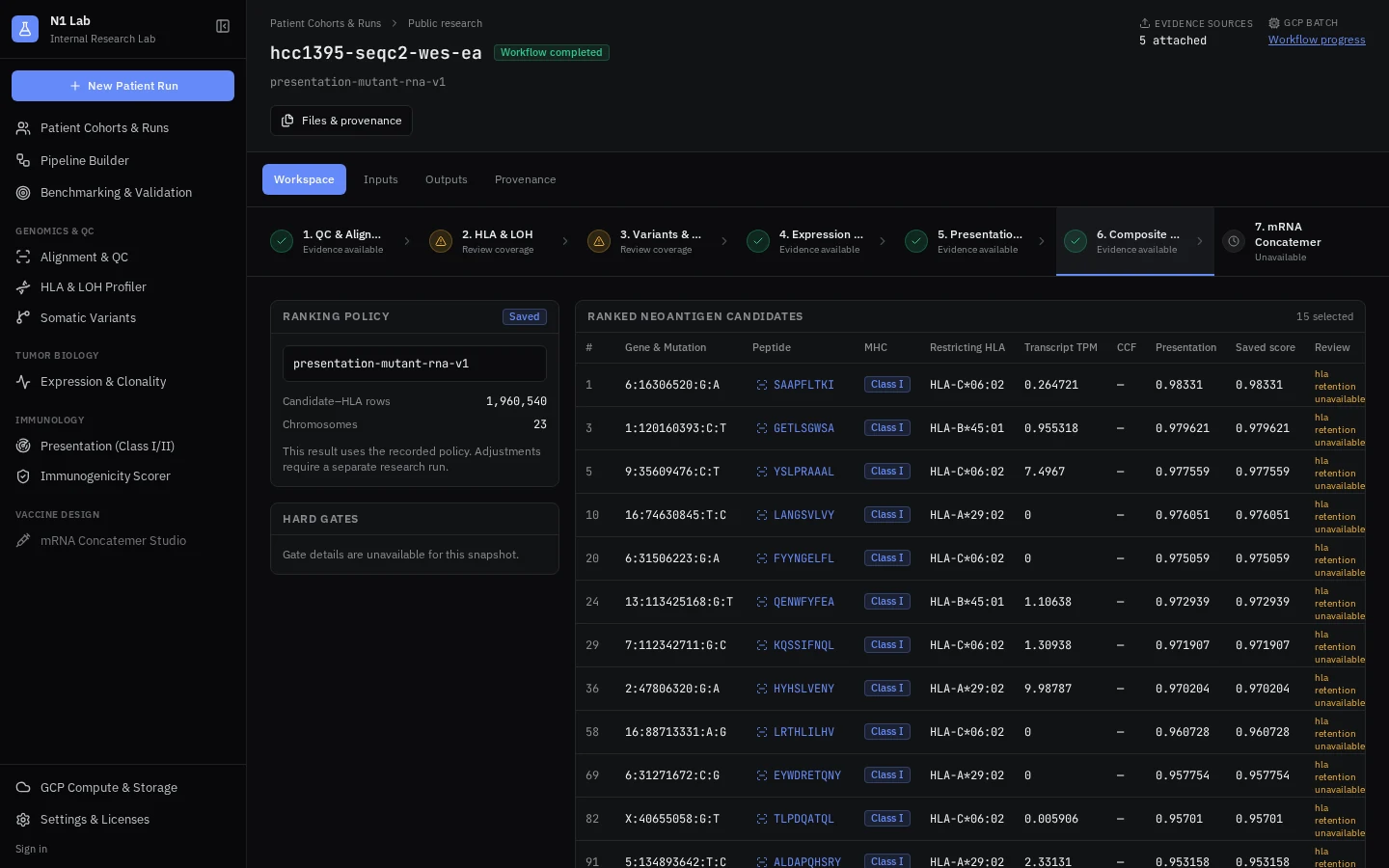
Open the saved HCC1395 breast cancer cell-line analysis and explore its evidence without rerunning sequencing.
Open the saved caseUse a supported research workflow for paired FASTQs, or start from a variant file to skip alignment and calling.
Use the peptide-binding tool directly when you already have sequences and the HLA alleles you want to test.
Review results stage by stage, compare shortlisted targets, and keep a record of how each list was generated. Some tools are available through saved runs in the pilot.
BWA-MEM2 · GATK Mutect2
Review sequencing and alignment summaries, then inspect variants called from tumor and matched-normal DNA.
Ensembl VEP
Trace each candidate peptide to the variant and transcript that produced it. Inspect the corresponding wild-type sequence when available.
STAR · Salmon · PyClone-VI
See whether RNA reads support a mutation and, when clonality evidence is available, how widely it occurs across tumor cells.
OptiType · T1K · MHCflurry
Review HLA evidence and predicted binding and presentation. Coverage depends on the allele, MHC class and model.
Binding baseline · Evidence-aware ranking
Compare saved shortlists and inspect what moved up, dropped out, or needs review under each ranking policy.
Nextflow DSL2 · Run manifests
Open stage outputs and trace the shortlist back to recorded inputs and run settings. Download supported artifacts for follow-up.
The pilot is a good fit for bioinformaticians, genomics scientists and computational oncology researchers with a public dataset and a question about which targets to follow up.
Inspect the evidence behind candidate targets and identify what still needs checking before follow-up experiments.
Revisit a published case, compare prioritization approaches, and keep a traceable record of the comparison.
Tell us what you’re working on and which public dataset or analysis step you’d like to try. Early access uses public or synthetic research data, with access approved by email.
Read the benchmark report